


News & Resources
Why Headline Commission Is the Wrong Place to Start When Comparing Travel Consortia?
If you’re reviewing your travel consortia this year, look beyond the headline. Promises of 100% commission can cost you profit.

Commission is gross income, not profit
Commission tells you how much you earn before costs. Profit is what remains after everything else has been taken into account.
That distinction matters more than ever. Modern travel businesses face a growing mix of fees, charges, compliance requirements, operational complexity and pressure on time. A consortia model that looks generous at the top line can quietly erode value elsewhere.
This is why headline commission is a poor proxy for real commercial performance.
The costs that headline commission doesn't show
When travel agencies dig deeper, they often find costs sitting outside the headline figure, including:
- Membership and licence fees
- Booking and transaction charges
- Merchant service rates
- Paid-for marketing or external support
- Time spent managing complexity, systems and suppliers
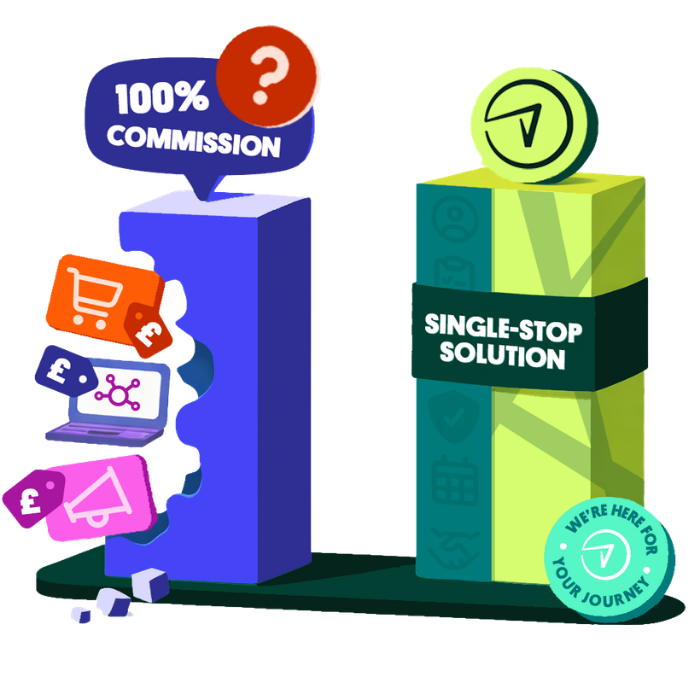
None of these are unusual on their own. But together, they shape what you actually retain at the end of the year.
For many businesses, the true cost of their consortia only becomes clear once they are already operating within the model.
Retained profit is a better measure of value
A more useful question to ask is “What do I actually keep, once everything is factored in?”. Retained profit looks beyond commission and considers the full commercial picture. It takes into account:

Total fees and charges

Support included versus paid for elsewhere

Marketing capability and reach

Business development and expertise

Time saved through simplicity and scale
This approach gives a far clearer view of long-term value than commission percentages alone.
Why support and marketing matter commercially
Support and marketing are often described as “extras”. In reality, they are commercial levers.
When marketing, business development and operational expertise are built into your consortia model, you avoid paying for them separately or trying to replicate them internally. That reduces cost, saves time, and improves decision-making.
Over time, those benefits compound. Businesses scale faster, operate with more confidence, and retain more profit in real terms.
This is why lower friction often delivers stronger outcomes than higher headline commission.
Comparing consortia properly
A more effective way to compare travel consortia is to step back from percentages and look at structure. These questions reveal far more about long-term value than commission alone.

How simple and transparent is the fee structure?
What support is included as standard?
How much marketing and commercial leverage does the model provide?
How much time and complexity does it remove from the business?
What does retained profit look like over a full year?
A more grown-up conversation about value
The most successful travel businesses tend to think in systems, not slogans.
They understand that profitability is shaped by structure, support and simplicity as much as by rates. And they choose partners who help remove friction across the whole business, not just process transactions.
If you are reviewing your consortia this year, headline commission is not the wrong place to look. It is just the wrong place to start.
If you want to explore how different consortia models compare once all costs and value are considered, you can take a look through our
membership options or speak to our team for a clear commercial walkthrough.
No pressure. Just clarity.
Share article